Methodology and Mission of the International IQ Test
Published by: International IQ Test
Last updated:
Mission
The International IQ Test, launched in 2018, is an online assessment that provides a free estimate of participants’ IQ scores worldwide.
Available in more than 40 languages and inspired by
Raven’s Progressive Matrices,
the test is designed to promote fairness by minimizing cultural bias.
Each year, we publish updated rankings and analyses across multiple dimensions (average IQ by country, average IQ by age, average IQ by field of study, IQ by education level, and more).
Filtering
Offering free IQ scores doesn’t prevent us from refining our scoring model or producing meaningful statistical insights.
Our annual statistics and rankings are processed using deduplication and anti-bot safeguards (for example, IP addresses and email addresses),
along with additional internal anti-cheating measures. The methodology behind these analyses is described in our published reports.
Methods
The International IQ Test’s global database—containing more than 16 million results—has enabled us to develop an IQ scoring model aligned with standard psychometric conventions (mean ≈ 100, SD ≈ 15).
One report, available here, used a final sample of 66,032 results collected over three consecutive years (2020, 2021, and 2022) and calibrated scores to approximate the global population.
It confirmed a worldwide mean IQ of 100 with a standard deviation of 15.
A second report, available here, examined the relationship between the general intelligence factor (g) and the test’s IQ scores, finding a strong association (about 0.943) that remained stable across two consecutive years.
This supports the conclusion that the test captures general cognitive ability.
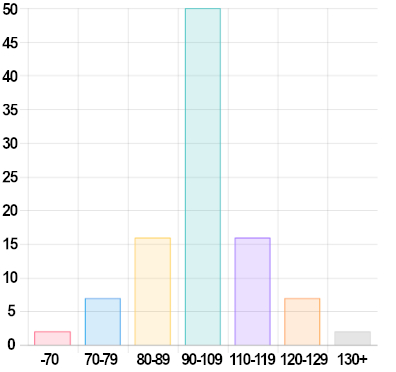
IQ distribution in the global population (mean = 100, SD = 15)
Rankings
The International IQ Test’s global database enables us to produce rankings and analyses that are frequently cited by online media outlets.
Each year, we update average IQ by country,
average IQ by age,
average IQ by field of study, and
IQ by education level, based on results from the previous year.
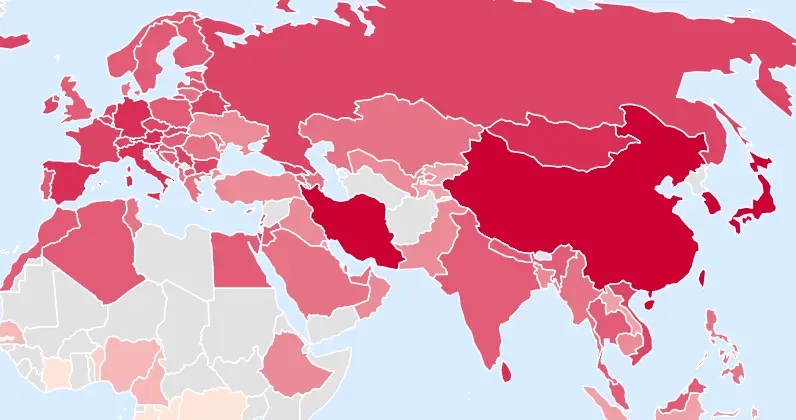
Excerpt from the country ranking map (dark red = higher score)
Limitations
Online IQ tests have inherent limitations, and the International IQ Test is no exception. For example:
-
The International IQ Test primarily reaches people with internet access (74% of the world’s population in 2025) and therefore does not yet represent those without access.
- Any online IQ test, no matter how carefully designed, provides an estimate—not a clinical diagnosis.
- Raven-style matrices do not measure other dimensions of intelligence (for example, verbal, social, and emotional intelligence).
Editorial responsibility: International IQ Test. You can reach us via the Contact section.